Ecofeminist icon Donna Haraway reminds us that “if we appreciate the foolishness of human exceptionalism then we know that becoming is always becoming with, in a contact zone where the outcome, where who is in the world, is at stake.” She is not alone in believing that building a more resilient future requires a new, cross-species perspective based on kinship and connectedness.
The Environmental Performance Agency (EPA) shares this view. With their Multispecies-Care-Survey they have recently launched a series of online workshops that invite people in the age of COVID-19 to familiarize themselves with their environment by means of small observational tasks and to get to know the diverse life forms in their direct environment.
For the Second Nature Lab, the collective will expand the project and develop a new series of online workshops that will put their political work into a global context. Together with the participants of their lab, they explore the urban space and its often unnoticed, even the smallest inhabitants.
The lab modules will be based on four protocols hosted on the EPA website. Protocol 01 was already released during NODE20. Protocols 02-04 will be launched at the same time as the Lab Module series. During each module session, participants will have the opportunity to "digest" the previous week's protocol and prepare for the upcoming protocol.
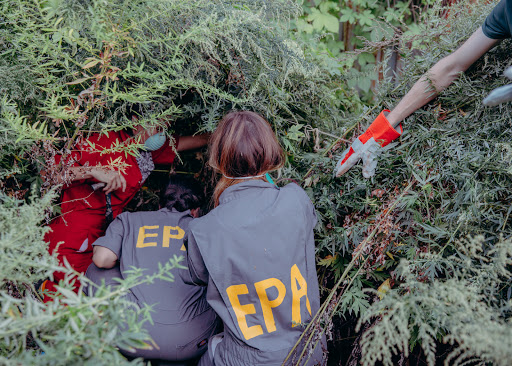
EPA & Gastagent*in aus der Next Epoch Seed Library streuen Samen im Mugwort Forest, 2017, (c) EPA.
Information
- What do I bring? Willingness to be outdoors, and explore new ways of conducting outdoor field observations. Readiness to follow protocol instructions, and embrace creativity in delivery and approach Willingness to investigate how personal observations, feelings, understanding and reactions to a site align or do not align with human-centric laws, rules, policies, and languages. Research policies and codes that relate to the management of urban greenspace. Willingness to question human supremacy thinking , and develop, in collaboration with plants and EPA agents, alternative ways of thinking and doing that embrace an ecolinguistic and ecosomatic experience.
- What do I need? Mobile phone, notebook, pencil, computer for research, warm clothes. Installation of the video conference tool BigBlueButton.
Process
4 November 2020 / MON 5-7pm CET – Multispecies Care Survey Training Session
EPA Agents andrea haenggi, Ellie Irons, Christopher Kennedy, and Artemisia vulgaris provide an introduction to the Multispecies Care Survey (MCS), a public engagement and data gathering initiative to articulate forms of environmental agency that de-center human supremacy and co-generate embodied plant-human care practices. The session will include a summary, demonstration, and Q&A about fall protocols 01-03 to prepare participants for self-directed fieldwork. We will touch on key concepts like “tree pit/Baumscheiben habitats,” “multispecies micro-commons,” “ruderal ecologies,” and “multisensorial fieldwork,” with the acknowledgement that these will be more fully defined and deepened through active participation in the protocols and weekly reading assignments.
2–20 November
Guided by the protocols on the MCS site—and with feedback and encouragement from the EPA team—participants will attune to and engage with the multispecies ecosystems that make up the tree pits/baumscheiben habitats in their city or town. Activities will include a walk on the sidewalks in your neighborhood to orient your attention to the area surrounding local street trees (“Baumscheiben”), a deepening of that attunement through multisensorial fieldwork strategies, and policy research into the ways that municipal and state regulations affect how care and control play out in these tree pit habitats. These fieldwork and research practices will be deepened through weekly reading, listening and/or watching assignments provided by the EPA team.
22 November / SUN 2–7 pm CET
This hands-on intensive will offer participants a chance to share, digest, and deploy the insights, questions, and concerns developed over the past three weeks of multisensorial fieldwork. These experiences will be used to collaboratively work towards a policy draft for “multispecies care” at the level of tree pit/Baumscheiben habitats. Together, in consultation with the plants and organisms that spoke to us during our fieldwork experience, we will begin to develop a collection of re-imagined and “hacked policies” that advocate for greater ecosocial justice in the care, maintenance, and recognition of all urban green space typologies and the living systems they support.
Outcome
Together we hope to move towards a fresh understanding of how land use, management and maintenance policies at the state and city level impact questions around multispecies solidarity and ecosocial justice in participants’ local habitats and beyond. With these insights, we will build capacity for reimagining and rewriting problematic forms of policy that erase nonhuman life and center only certain, privileged forms of human life. With the data and insights gathered through this survey, EPA will ultimately work towards drafting a new piece of policy, The Multispecies Act. This Act aims to offer a set of embodied, actionable principles for centering spontaneous urban plant life as one means (among many) of contending with the failure of our environmental regulatory apparatus to deliver policy that protects and values life both human and non-human.
Registration
The number of participants is limited. Please register here and share a few words about your motivation with us!